The Armillary World
A teaching space you fly through: an armillary sphere at the centre, and eight concentric topic zones around it, each a ring carrying exhibits that connect a piece of mathematics to something you can look at. Number, Form, Wave, Symmetry, Light, Growth, Motion, Cosmos — 991 nodes in about 300 KB.
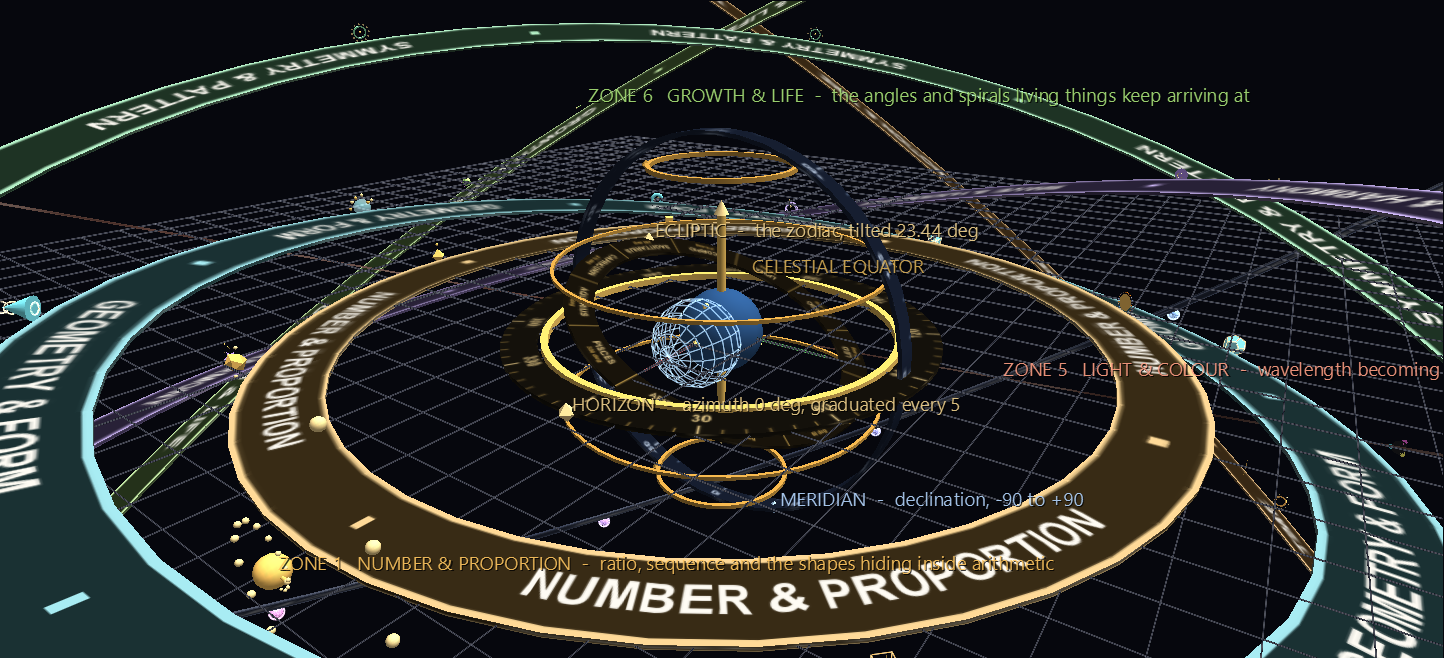
It is also the first scene built on the Flat Ring geometry, added the same day: a torus whose cross-section is a rectangle instead of a circle. A rounded torus reads as soft tubing, and its highlight slides around the tube. An instrument is made of machined bands with square edges — and only a flat face will hold a legible texture, which is what every graduation, zodiac sign and zone name here is.
Try it: download this example below (or the full examples set), then open Armillary_World_Example/Armillary_World/armillary_world_gv_node.csv — or drag its folder onto the window.
The instrument
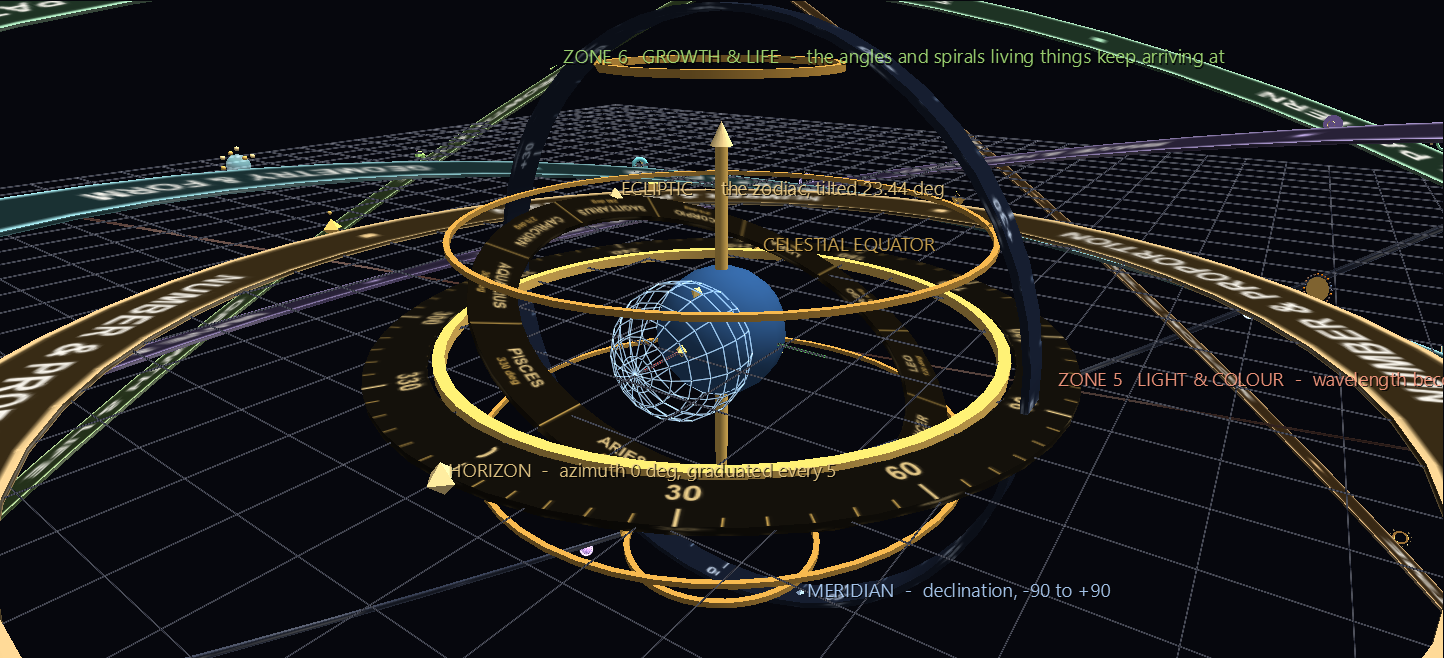
Horizon, meridian, celestial equator, ecliptic, the two tropics and the two polar circles, plus a globe and a polar axis — a real armillary, to a real obliquity of 23.44°.
Three of its rings are graduated, and those are the ones the geometry exists for: the horizon carries an azimuth dial marked every 5°, the meridian carries declination from −90 to +90, and the ecliptic carries the twelve signs of the zodiac at 30° each. Each is an image wrapped once around a flat band.
The declination numbering is worth a look if you like this sort of thing. Declination is not linear in the angle around the ring — it climbs to +90 and comes back down — so every round value except the poles appears twice, at θ = acos(−sin δ). The generator solves for those positions rather than spacing the numbers evenly, which is what an instrument maker would have had to do.
The zones
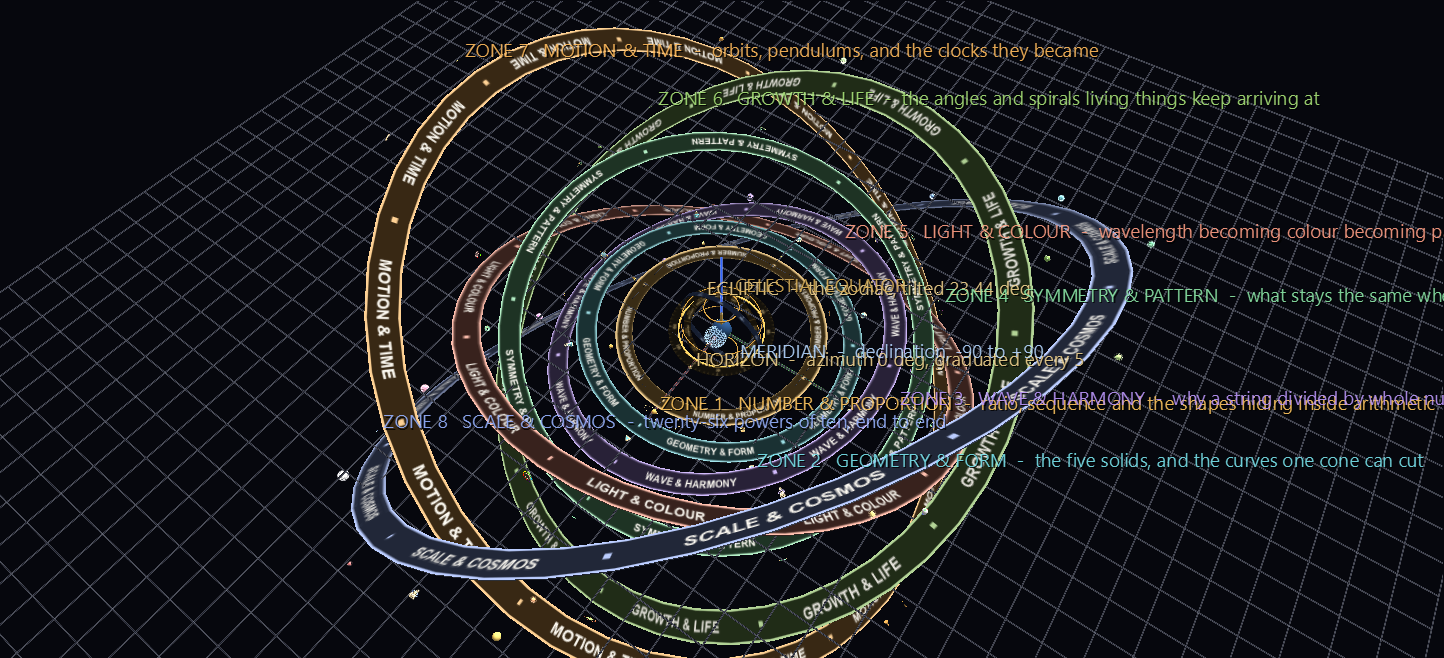
Each zone is three things: a thin rail carrying its exhibits, a wide textured band with the zone's name wrapped around it, and one gateway — a pin glyph with the zone's name pinned on, sitting on the rail. The gateway is the thing to click, or to press F on.
| Zone | Exhibits include | |
|---|---|---|
| 1 | Number & Proportion | φ, Fibonacci, the primes, π, Pascal, the golden rectangle |
| 2 | Geometry & Form | the five Platonic solids, the conic sections, the kissing number |
| 3 | Wave & Harmony | the harmonic series, octaves, fifths and fourths, standing waves, beats |
| 4 | Symmetry & Pattern | rosettes of 3-, 4-, 5-, 6-, 8- and 12-fold symmetry |
| 5 | Light & Colour | the visible spectrum, additive and subtractive primaries, refraction, the rainbow |
| 6 | Growth & Life | phyllotaxis at 137.5°, a branching tree, cell division, the nautilus, a double helix |
| 7 | Motion & Time | a working orrery, pendulums, a turning clock face, Kepler's second law |
| 8 | Scale & Cosmos | twenty-six powers of ten, from a nucleus to the observable universe |
Every node in the scene carries a label, so pressing T explains any glyph you are looking at. Only the ten gateway and instrument-ring labels are pinned on permanently — the rest would make an overview unreadable.
Several things move, all of it from rotate_rate_z in the CSV rather than from Channels: each zone rail turns at its own slow rate, the orrery's four planets keep their real period ratios, and the clock face turns.
Three rules this scene is built on
These are the non-obvious parts of authoring with rings, and they are the parts worth reusing.
1. A ring that carries children is scaled uniformly
A Flat Ring's radial width comes from ratio and its height from scale_z, so a wide thin dial needs scale_z ≠ scale_x. But children inherit their parent's per-axis scale, so a child of an (S, S, Z) ring comes out stretched. Hence the split used throughout:
- Rails — uniform scale, small
ratio. The cross-section comes out square (side2 × ratio × S), which is exactly the thin machined hoop you wanted anyway, and exhibits riding it inherit a clean uniformS. - Bands — wide (large
ratio), thin (smallscale_z), textured, and childless.
2. A ring's texture must be built at the ring's own aspect ratio
u runs once around the whole circumference while v crosses the narrow reading face, so the canvas a ring hands its texture is enormously wide: 2πR / face width, which for a thin hoop is 150:1 or worse.
There are two ways to get this wrong and this scene hit both on the way here. Give the image the wrong aspect and every letter smears sideways — a 12:1 image on a 180:1 band stretches each one 15×. Fix the aspect by repeating the content more times and you are right in principle but starving each copy of pixels: 22 copies of a name across a 1024-pixel image is 46 pixels each, which renders as a solid white streak.
So the consequence is a design constraint, not a coding one: a ring that carries readable text has to be a wide band, on the order of 10–20% of its own radius. Which is exactly what a real armillary's zodiac ring is. Note also that the reading face differs by ring type — for a flat dial read face-on it is the band's radial width; for a tall hoop read on its outer wall it is the band's thickness.
3. Tilting a ring takes two angles, not one
rotation_mode = EULER_XYZ composes as Rx·Ry·Rz applied to a column vector, so rotate_z turns first and cannot swing a tilt's direction around afterwards. The generator's aim_normal(tilt, azimuth) solves Rx(a)·Ry(b)·(0,0,1) for the ring axis it wants and returns the pair. Every tilted ring here goes through it. See Topologies for the wider version of this — placement aims a glyph, rotation poses it.
Two more facts the generator relies on, both verified against the engine rather than assumed: a child of a TOPO_TORUS parent at translate_y = 0, translate_z = 0 lands exactly on the parent's own radius, with translate_z pushing it outward as a fraction of that radius; and an exhibit's local +Z points radially outward from the world centre, which is why the tree in Zone 6 grows outward from its ring.
Known limits of this first pass
Stated plainly, because they are the interesting part of building a world at this scale:
- The gateway labels crowd near the middle in a whole-world overview. They are deliberately spread around their rings, each at a different angle, but a nested system seen from outside projects its inner rings into a small part of the frame no matter where you put them.
- The zones are thematic, not spatial. An exhibit's distance from the centre says which topic it belongs to and nothing else. A world that used radius to mean scale — the Zone 8 idea applied to everything — would be a different and probably better scene.
- Nothing is animated with Channels yet. All the motion here is
rotate_rate_z.
Rebuilding
python build_armillary_world.py [--out-dir DIR]
Regenerates the CSV and all eleven textures. Needs Pillow; everything else is plain Python.