Epitrochoid Generator
Tools → Epitrochoid Generator… (Ctrl+E)
Designs an epicycle chain — a Fourier series built out of nested Torus-topology parents — and lets the pen at the end of the chain draw its own path.
Unlike the Tree Designer, which exports a Glyph Composer template, this one writes node CSVs directly. It has to: a tree is a recipe, but an epicycle chain's whole point is the traced curve, and that curve only exists once the chain has been walked. Save Scene therefore writes a complete, loadable folder.
The idea
Five nodes, each the child of the last, every one of them Torus topology, each
spinning its translate_x at a constant rate. Because each level's angle is
measured in its parent's rotating frame, the angles compose down the chain,
and the pen at the end traces the sum of the arms — which is exactly what a
Fourier series is.
Each arm contributes one term:
| control | what it sets | in the series |
|---|---|---|
| Rate X | orbit angle, degrees per frame | the harmonic |
| Length | the arm's radius, world units | the amplitude |
| Phase X | starting orbit angle | the phase |
and two more take the figure out of the plane:
| control | what it does |
|---|---|
| Tilt | leans this arm's orbit plane out of the previous arm's, in degrees |
| Tube / Rate Y / Phase Y | gives the arm a second circle riding the first, around the torus tube |
The harmonic ladder
Rates do not map to harmonics one-for-one. Each level's rotate = (90, 90, 0)
cancels the base rotation Torus topology applies to its children, and that
cancellation leaves the frame's handedness flipped. So the magnitudes add,
with the sign alternating:
h₁ = r₁
hₖ = hₖ₋₁ + (−1)^(k−1) · rₖ
Rates (+1, −1, +1, −1) therefore climb to harmonics 1, 2, 3, 4 rather than
collapsing to 1, 0, 1, 0. The readout under the preview shows the ladder your
current rates produce, so you never have to work it out by hand.
That rotation is load-bearing, not decoration. Without it the rings tip 90° out of plane at every level, the chain corkscrews off the z = 0 plane, and the construction stops being a Fourier series at all.
Amplitudes live one level up
A node's torus is the circle its child rides, and its radius is that node's
cumulative scale — so the arm lengths you type are produced by the scale of the
node one level up. The designer telescopes that for you; you author every
Length directly in world units at any depth.
The tube is a sideband generator
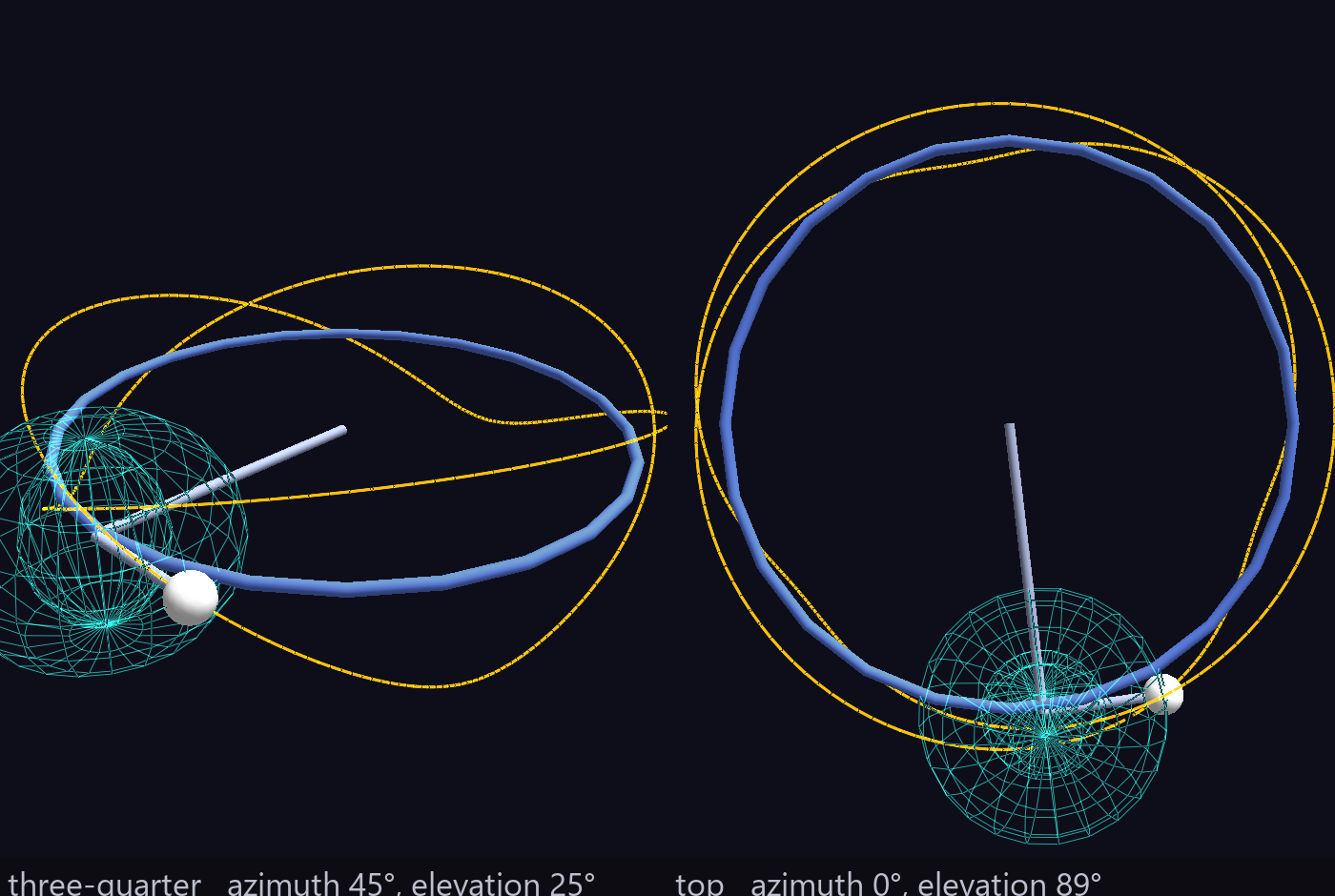
An arm at harmonic h with tube rate r contributes h, h − r and h + r in the plane, plus pure out-of-plane motion at r. That is what turns a flat rosette into a genuine space curve, and with two arms it is a torus knot.
The tube is carved out of the arm rather than added to it, so Length stays
the true arm length, and the parent's drawn ring becomes the tube its child
actually travels. Rings thicker than a hairline are drawn as wireframe —
a solid one at that size is an opaque doughnut that hides the mechanism it
exists to show.
The readout
Under the preview, all of it measured from the traced path rather than predicted:
- Harmonic ladder — what your rates actually produce.
- Closes in N frames — the exact period after which every angle is back where it started, computed in rationals so ½ or ⅓ give the right answer. A curve that closes is a figure; one that does not is a smear, and the readout says which you have.
- Spectrum — the complex DFT of the traced curve, in the same units as Rate X. Sidebands from Tube and Tilt show up here even though you never typed them.
- Figure — planar or 3-D and how deep, plus half-span and node count.
Output
Save Scene (CSV)… writes a folder containing:
<name>_gv_node.csv— the chain, the linkage, and the trail<name>_gv_tag.csv— a label on every structural node<name>_gv_ch-map.csv+<name>_gv_ch-tracks.csv— only when Self-drawing trail is on
One folder per scene is required, not tidiness: GlyphViz auto-loads Channels only when it finds exactly one ch-map and one ch-tracks file beside the node CSV. Two candidates in one directory disable Channels entirely, and silently.
Insert into Scene adds the design to the scene already open, as new roots.
Save Design… writes the parameters as .json so a hand-tuned design can be
reopened here later. It is never needed to view or share a result — that is
what the CSVs are for.
The trail
The traced curve is a transparent Plot-topology parent holding one Point-geometry bead per sampled frame, at the pen's world position. Plot draws a polyline through its children in CSV row order, so that polyline is the curve.
Three details that matter if you build one by hand:
- The Plot parent is
color_a = 0, nothide = 1. A hidden plot parent suppresses the polyline entirely. - The line takes its colour from each bead and its width from the
parent's
ratio × 20pixels. - Bead positions are sampled from the live engine, not recomputed — which is why the trail sits on the curve to the CSV's own write precision.
With Self-drawing trail on, each bead's alpha steps from 0 as the pen arrives, so the curve draws itself during playback (Space in the main window). Beads share an alpha channel in small groups to keep the tracks file compact; a group lights when its last bead is reached, so the line trails the pen by a fraction of a second rather than ever running ahead of it.
Preview
The preview always runs on translate_rate with the trail fully drawn, even
when Self-drawing is checked — so you can watch the pen ride a curve that was
computed independently of it, which is the correctness check, on screen.
Self-drawing changes only what Save Scene writes.
The camera stays where you put it across edits. Reset View re-frames.
Worked examples
examples/Fourier_Epicycles_Example/ ships six scenes built from this same
engine — the planar original, a self-drawing version, a square wave from odd
harmonics, and three that leave the plane. Its README explains each one.
What the curve is called
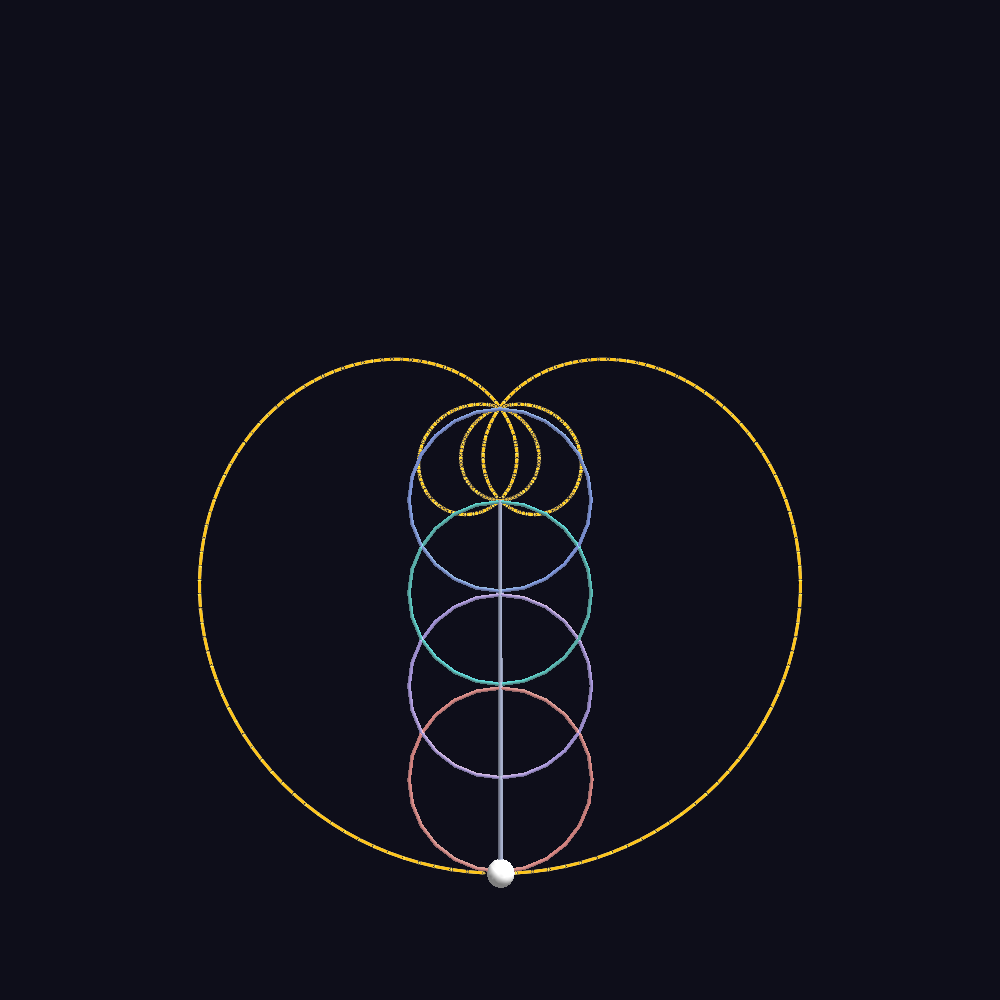
Not a Lissajous figure — that is a product of two independent 1-D oscillations. This is a sum of rotating vectors: the epitrochoid family. Two terms give the textbook epitrochoid/hypotrochoid (the Spirograph curve); n terms give an epicyclic curve, or a truncated Fourier series curve. It is the same construction as the classical deferent-and-epicycle planetary models, which is why the linkage on screen looks like an orrery.